This little fella was not bothered by my presence, but only interested in a good meal. Today's menu consisted of seeds from this spruce tree cone. They are always in search of nuts too and will eat just about anything in a backyard bird feeder. Sunflower seeds and peanuts are a couple of favorites with our Northern Red Squirrels. Sharing them with the backyard birds can be a challenge though. I guess that is why they are known to most as pests. You must admit, this little squirrel wins "The Cutest Pest Ever" award!
Tuesday, October 14, 2014
Wednesday, October 8, 2014
American Dagger Moth Caterpillar
I just couldn't help myself to share a little
bit of "humor" with these photos!!
This little fella is quite smart too!!
Maybe caterpillars can read!! (wink wink)
He is having a snooze under this ''caterpillar sign"
Maybe caterpillars can read!! (wink wink)
He is having a snooze under this ''caterpillar sign"
American Dagger Moth Caterpillars are large caterpillars that are typically clothed in long lemon yellow hairs. The hairs turn pale yellow or white when they are near the cocoon stage. They have a thick black tuft at the end and two pairs of tufts along their middle, which is a very distinctive characteristic pattern.
American Dagger Moth Caterpillars are a forest moth species. They feed on maples, willows, poplars, oaks, and alders. You can observe them until the end of October or November. They will emerge the following summer as a brown moth after spending a winter inside their cocoons.
Thursday, August 21, 2014
Dragonflies and Damselflies
When I first spotted this Golden-ringed Dragonfly, I thought it was simply resting on the tree branch, but as I walked closer, I realized he was eating what was left of a Keeled Skimmer Dragonfly. Dragonflies will feed on large insects such as wasps, beetles, bumblebees, damselflies, and other dragonflies. They are very fast fliers; one of the largest in the dragonfly family and have a wingspan of almost 10 cm....
A pair of Damselflies during courtship on the lake grass.
| In Love............... |
The reflection of their courting pose, makes a shape of heart from my point of view.
In reality, when damselflies mate, they actually form a heart-shaped pose or a mating wheel.
Tuesday, August 19, 2014
Common Loon
Common Loons can be seen along the coastlines of rivers and lakes across North America. Although very sensitive to human disturbance, we were lucky enough to capture this handsome male close by. He was focused on meeting up with the female and her baby which we spotted out further in the lake. They have a very distinctive call that echos across the wilderness and it is music to our ears every time we hear them.
Thursday, August 7, 2014
Black-Eyed Susan
Black-Eyed Susans are one of the most popular wildflowers of North America and come in yellow, red and orange.
Bees and Butterflies, and a variety of insects are attracted to Black-Eyed Susans for the nectar. They move pollen from one plant to another as they drink the nectar, causing it to grow fruits and seeds that can move about easily with the wind.
Thursday, July 31, 2014
Nectar Cafe
This fascinating Bumblebee is seen collecting nectar and pollen from a Black Knapweed.
This wild flowering perennial provides for all kinds of insects including butterflies, bees and wasps. Bees are extremely important pollinators for agriculture which include many varieties of fruits and vegetation.
Black Knapweed can be cut down in autumn after flowering or left through the winter so that its seeds provide a food source for the birds.
Monday, July 28, 2014
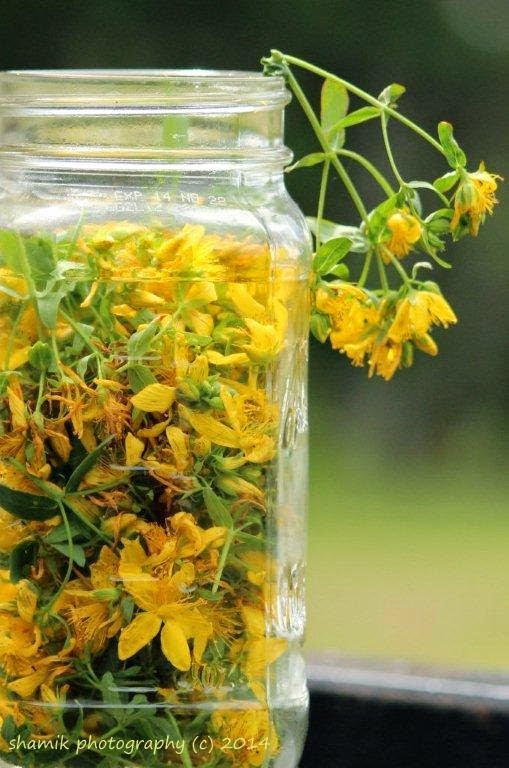
St John's Wort (Hypericum Perforatum)
St John's Wort flowers (Hypericum perforatum) were hand picked from our property and local area ....
It is also safe to use on your pets!! We healed our pekin duck's foot... See how : http://shamik4.blogspot.ca/2012/09/homeopathy-for-my-pekin-duck.html
** The 2015 harvesting season is here and more of this wonderful oil
will be available for purchase mid September. If you would like a
custom order, please email us and we will be happy to accommodate. We have some excellent quality stock left from 2014 that can be purchased here: St John's Wort Oil (2014) or on our Ebay store
St John’s Wort Oil is created
by infusing the flowers in a fixed oil (I use 100% organic sunflower
oil) and preserved for at least 6 weeks or longer in the sun....
The active components in St
John's Wort are found in the buds, flowers, and newest leaves.
St John's Wort (Hypericum Perforatum) is a very effective anti-inflammatory.... It is excellent for treating insect
bites and stings, cuts, burns, bruises, sprains and speeds recovery
time dramatically... This amazing oil is a must have in a first aid kit.
St John's Wort Oil (30 ml glass bottle) - 100% organic
It is also safe to use on your pets!! We healed our pekin duck's foot... See how : http://shamik4.blogspot.ca/2012/09/homeopathy-for-my-pekin-duck.html
The St John's Wort flower is a favorite of the bumble bee
****This amazing oil has an excellent shelf life if stored in a cool, dark place
DISCLAIMER:
These statements have not been evaluated by the FDA. These products are
not intended to diagnose, treat, prevent or cure any disease. Customers
are reminded that it is entirely of their own accord, right and
responsibility to make educated choices with their own, and their
family's, health care. Always consult a physician prior to the use of
any herbal product or service.
Tuesday, July 22, 2014
Little Green Grasshopper
Green grasshoppers indicate fresh starts
or new beginnings.
or new beginnings.
Grasshoppers symbolize GOOD LUCK !!!!
Grasshoppers definitely have meaning! They teach you to take a chance,
to leap forward – they don’t leap backwards.
They also have “ears” in
their legs, so they remind you to trust your inner voice...
Monday, July 21, 2014
Fish Hawk
This Fish Hawk, also known as an Osprey
was in search for a meal
He sighted his prey and you can see his talons opening up as he makes his second attempt at entering the water....Osprey's can catch fish, on average, one in every four dives.
Landing on his prey!!
Heading back to his perch with supper!!
Did you know?
Sunday, July 20, 2014
Watch Me Grow
Dark-Eyed Junco eggs nestled in the perennial garden by our house!! The female incubates the eggs for 12-13 days and the nestling period is approximately 10-13 days!!
All four babies were hatched successfully
and are growing very quickly!!
Mom and Dad are not too far away!!
These little babies fledged the nest the day after this photo was taken!! We are fortunate to have them with us year round!! They will soon be introduced to our backyard feeders.... They prefer millet over sunflower seeds. Dark-Eyed
Juncos also eat insects including flies, moths, butterflies, ants, wasps and beetles.
Monday, July 14, 2014
Dragonfly
Are dragonflies symbolic to you?
- Dragonflies spend most of their lifespan under water during the larval stage. Then, they spend only a few short months as a flying insect.
- They are very fascinating to watch. They can move each of their four wings independently.
- They can move straight up or down, and fly up to 30 miles per hour. They can also fly backwards, like a hummingbird!!
Dragonflies are very inspirational and live life to the fullest with no regrets!!
Wednesday, July 9, 2014
Wild Iris
Saturday, July 5, 2014
Focused
Philly has no room for boredom here at the farm as he is entertained by our feathered friends outside....He is naturally curious and there is never a dull moment.
Canadian Geographic likes Philly too!!
Tuesday, June 24, 2014
Early Bird Gets the Worm
| American Robin |
Depending on the area and the resources, Robins can have up to three clutches in a year....Sometimes the mother lays her second clutch of eggs before the babies leave the nest at two weeks of age. The male assists with feeding the first brood for another couple of weeks until they are able to fend for themselves and are fully independent, while the mother tends to the second clutch, and if lucky, the third.
If you have a good supply of food, shelter and water on your property, you will be sure to attract all varieties of songbirds throughout the year....
Saturday, June 21, 2014
Great Blue Heron
The Great Blue Heron has a wingspan of almost 7 feet and stands almost 4 feet tall!!
Monday, June 16, 2014
Bad Hair Day
Female Purple Finch enjoying some sunshine at the feeder
~
~
Then the next day....
~
What a difference a day can make.... !!
Despite the rain, our feathered friends were visiting the feeders all day long!!
(although soaking wet, she's still a little cutie)
Friday, June 13, 2014
Feathers For Our Feathered Friends
Our Pekin duck and chicken feathers are in high demand these days........ They are plentiful and free for the taking!!
This adorable male Tree Swallow was playing with this feather before going to the nest box with it.... Clean, loose feathers are important for Tree Swallows. They line their nests with them, lots of them....It keeps the babies comfortable and dry.
They are everywhere... I found this feather hanging onto a dandelion.... The first thing in the morning when the ducks and chickens emerge from their house, is the best time to capture this spectacle!! The Tree Swallows are not far; look up, and you will see them swooping and gliding everywhere.... In the meantime, they are in search of a freshly preened feather from down below.... don't blink if you want to witness the take, because they are fast!!
There he goes!! As you can see, there are a few more feathers close by, but they won't be there for long....
The male Tree Swallow was having a little bit of a problem getting this feather in the nesting box.... He was trying so hard.... I looked closer and noticed that the hollow shaft, also known as calamus (the pointed end pictured just above his head) was too long to fit in the nesting hole. I waited until he eventually dropped the feather. I assisted by snipping the calamus off. Then, I tossed the feather into the wind and a few seconds later, he caught it in mid-air!!
And there he goes with it to the nest... !! Oh, you're welcome, glad to help out (wink, wink)
We have been watching the Tree Swallows collect many of these naturally shed feathers and take them to their nest over the past two weeks. Here's a peek when they arrived.
The female and male both work very hard in the nest making process....
Rise and shine.....
Say hi to Squirt....she is happy, along with all of the other Pekin ducks to contribute her soft downy feathers to the nesting Tree Swallows!!
Tuesday, June 3, 2014
Our Tree Swallows are Back !!
This male tree swallow is stretching. He has been sitting on this branch for a few minutes keeping a close eye on his female.
We have a breeding pair nesting in the box again this year....When the female is producing her eggs, she needs extra calcium, so we offer some crushed egg shells for them to eat. We raise laying chickens, so there are plenty of eggs!! And, our pekin ducks help out too....When the tree swallow prepares the nest, they are looking for soft bedding and one of the supplies they seek are freshly preened feathers.
Here is the very dedicated female looking quite comfortable and ready to lay her eggs!! If you want to read some interesting facts about the tree swallow or see some more images of them, stop by over here and check them out!!
Labels:
bird,
eggs,
feathers,
nest,
nestlings,
shamik photography,
tree swallow
Thursday, May 29, 2014
For the Love of Hummers ~
I am dedicating this blog post to my Grandmother....
We both share our love for birds. Sometimes, I will call her and ask her if she saw this kind of bird, or that kind of bird, or I will say, "Can you check the bird book Gran", but one thing we know for certain is, we love our hummers.... and Gran always says, ''Make sure you put a little extra sugar in their water before they fly south. It gives them extra energy to make their long journey". So, that is what we do....
This is an adult male....
He is called a Ruby-Throated Hummingbird
but I call him ''Sweetie'' because he is exactly that....
Hummingbirds are
known for their ability to fly backwards, upside down, and to hover.
Few other birds compare in their ability to perform such aerial tricks.
They also possess the fewest number of feathers ever counted on a bird.
Hummingbirds are
known for their ability to fly backwards, upside down, and to hover.
Few other birds compare in their ability to perform such aerial tricks.
They also possess the fewest number of feathers ever counted on a bird.
Hummingbirds are
known for their ability to fly backwards, upside down, and to hover.
Few other birds compare in their ability to perform such aerial tricks.
They also possess the fewest number of feathers ever counted on a bird.
Hummingbirds are known for their awesome abilities....!!
They can hover, fly backwards and even upside down....!!
I am hoping one of these days, that I will be able to find the female in her nest. I would quietly photograph her from a distance with her babies....That would be awesome!!
Until next time.... or as Gran J would say "Loads of Love" xoxo
Subscribe to:
Posts (Atom)